
Development journal
Dev Blog #4: Why Name It StormTome?
Originally, the project was named Blade Quest. Growing up, I was fascinated by the Quest games, notably Space Quest, King's Quest, and Hero's Quest. The last one was particularly important because of its role-playing mechanics. It introduced me to the idea that a game could be played in different ways, depending on the class I chose and how I developed my character.
Plus, Blade Quest sounded cool.

The problem was finding a meaning that would last. What was a Blade Quest? Were you searching for one particular blade? What happened when you found it? Was this a world where everyone carried a blade, or where finding your own was part of coming of age?
I could come up with explanations, but none had much staying power. The name was also already being used by other projects, which would make mine harder to distinguish. I needed something that gave the world a direction and that people could find.
A Cataclysmic Event
My favorite book series growing up was Dragonlance, especially Dragons of Autumn Twilight by Margaret Weis and Tracy Hickman. The idea of a world scarred by a cataclysm stayed with me: something had happened long before the characters arrived, and its consequences were still shaping their lives.
I did not want to build StormTome around a pantheon of gods punishing human hubris. I preferred a struggle for control of magic, with that struggle eventually going completely out of control. Ideally, a magical artifact would sit at the center of it.
That gave the name a job to do. It could describe something important in the world, something powerful enough to explain why the world had been changed.
The Quest for Uniqueness
Finding a distinctive name on the Internet is difficult. A combination can sound original until a search turns up another game, a book, or someone's long-running project.
As I wrote in StormTome: Worldbuilding and the Limits of Generative AI, I tried using LLMs to help with the search. The models I was using tended to suggest familiar combinations, and many of the names were already taken in one way or another. Asking for something unique did not solve the problem.
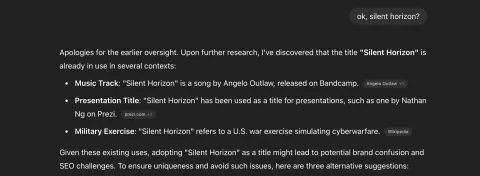
We changed the process into a kind of random tournament. We generated combinations of words, then pitted the names against each other to see which ones I preferred. Instead of expecting the model to deliver the perfect name, I could use it to explore the ingredients.
“Storm” kept appearing in the winning names, although finding its partner took longer. “Storm Orb” suggested a convincing cataclysmic object, but saying it aloud made it sound more like “stor-morb.” A name also needs to work when someone speaks it.
After a few iterations, we arrived at “Tome.” StormTome sounded strong, suggested a magical artifact, and stood out in the searches I made. It gave me something I could build around.
It is frustrating to bend part of the creative process around search engines. But discovery is a challenge for any new game. If someone remembers the name and looks it up, I want them to find the project. StormTome gave me a name I liked, a direction for the world, and a better chance of being found.